By Kai Nakamura · Production roaster & equipment editor · Updated 2026-09-17
Giesen W15A vs Loring S15 Kestrel
Variable drum speed vs fixed recirculation — same capacity, different heat physics
Giesen wins cupping flexibility; Loring wins when afterburner compliance is non-negotiable.
Also searched: loring s15 kestrel vs giesen w15a
Decision picker
Specification matrix
| Spec | Giesen W15A | Loring S15 Kestrel |
|---|---|---|
| Batch capacity | 15 kg | 15 kg |
| Heat source | 380,000 BTU/h gas | 350,000 BTU/h gas |
| Drum / chamber | Steel drum | Single-wall steel |
| Batch time (typical) | 13 min | 12 min |
| Throughput (modelled) | 52.9 kg/h | 56.3 kg/h |
| Street price band | $98,000 USD | $185,000 USD |
| Exhaust | 850 CFM | 800 CFM |
| Lead time | 18 wks — confirm with dealer | 28 wks — confirm with dealer |
| Automation | Giesen Software Suite | Smart Roast PLC |
| Service hub | Netherlands | USA |
Batch capacity
Giesen
15 kgLoring
15 kgHeat source
Giesen
380,000 BTU/h gasLoring
350,000 BTU/h gasDrum / chamber
Giesen
Steel drumLoring
Single-wall steelBatch time (typical)
Giesen
13 minLoring
12 minThroughput (modelled)
Giesen
52.9 kg/hLoring
56.3 kg/hStreet price band
Giesen
$98,000 USDLoring
$185,000 USDExhaust
Giesen
850 CFMLoring
800 CFMLead time
Giesen
18 wks — confirm with dealerLoring
28 wks — confirm with dealerAutomation
Giesen
Giesen Software SuiteLoring
Smart Roast PLCService hub
Giesen
NetherlandsLoring
USAQualitative scores — verify against your roast program
Why this split
Loring S15 Kestrel leads on the weighted score for most boutiques we modelled.
Giesen stays competitive when software-first workflow outweighs the price gap.
Deep dives
Recirculation vs open exhaust
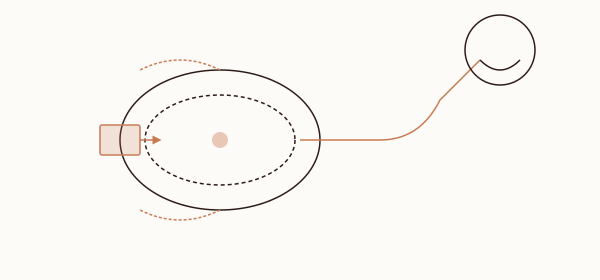
Loring S15 Kestrel recirculates hot gas — exhaust temperature drops and afterburner load shrinks.
Open-drum platforms vent more heat per batch. Model your gas meter at 50% and 75% charge before signing.
Verify with vendor
- • Request OEM combustion efficiency curve
- • Confirm AHJ afterburner requirement for your address
IR radiant heat transfer
Diedrich IR drums radiate through a double-wall — different first-crack timing than convection.
Operators switching from Probat or Giesen need 15–20 calibration batches, not a copied profile.
- Log development time ratio across 3 charge weights
- Compare ground colour at same end temp
What to verify with your dealer
Neither OEM publishes binding street prices — quotes move with queue and freight.
Verify with vendor
- • Confirm Giesen W15A lead time and freight to your dock
- • Confirm Loring S15 Kestrel install kit and probe package included
- • Ask for three references at similar elevation and batch size
Side-by-side
Giesen strengths & gaps
- Software-first workflow
- Variable drum speed
- Software learning curve
Loring strengths & gaps
- Low NOx afterburner standard
- 35% gas savings vs conventional
- Premium price